Net Weight vs Gross Weight
In logistics, shipping, and product packaging, weight affects how much it costs to move goods, how inventory is stored, and whether companies follow legal rules. Net weight and gross weight are two standard terms used in this field. Knowing the difference helps businesses ship items correctly and stop mistakes during delivery.
The comparison of Net Weight vs Gross Weight matters most in manufacturing, online sales, and freight operations. These figures show the real product mass and the full mass of the package including boxes, labels, and other shipping supplies. Understanding which is net weight and which is gross weight leads to fair pricing, better loading choices, and smoother international deliveries.
This difference between gross and net weight helps logistics teams calculate transportation costs and plan shipments more efficiently.
What Is Net Weight?
Net weight means the weight of just the product, without including any packaging, containers, or other materials used for wrapping. So, it is the actual quantity of the product that the customer gets. To give you an example, a packet of rice weighs 1 kg if you exclude the packet itself; so 1 kg would be the net weight of the product.
The product labels typically have net weight stated on them by the manufacturers so that the customers are clear about how much product they are buying.
How To Calculate Net Weight?
Net weight can be calculated by subtracting the packaging weight from the total weight of the product.
Formula:
Net Weight = Gross Weight − Packaging Weight
Example:
|
Item |
Weight |
|
Total Weight (Product + Packaging) |
1050 g |
|
Packaging Weight |
50 g |
| Net Weight |
1000 g |
Therefore, the actual weight of the product inside is 1000 g (1 kg).
What Is Gross Weight?
Gross weight, on the other hand, is the combined weight of the product and all its packaging materials that form a shipment. It could be the boxes cartons pallets, wrapping materials, and containers used for the transportation.
In fact, the gross weight is one of the factors in logistics that influence the cost of transportation and helps to make sure that shipments will not exceed the maximum capacity of the vehicle.
Here is a very simple example: a product weighs 1 kg and its packaging weighs 200 g. So, the gross weight of the shipment becomes 1.2 kg.
How to Calculate Gross Weight?
Gross weight can be calculated by adding the product weight and packaging weight.
Formula:
Gross Weight = Net Weight + Packaging Weight
Example
|
Item |
Weight |
|
Net Product Weight |
5 kg |
|
Packaging Weight |
0.5 kg |
|
Gross Weight |
5.5 kg |
The gross weight of the shipment is 5.5 kg.
Why Net Weight and Gross Weight Are Important in Logistics
Understanding the difference between Net Weight and Gross Weight is a must for the smooth running of logistics operations. These are the primary measurement tools that allow businesses to plan their shipment, estimate costs, and abide by transportation rules.
Helps Calculate Accurate Shipping Costs
Shipping companies calculate the cost of sending goods primarily based on the weight of the shipment. The correct knowledge of gross weight will help the shipping company work out the transportation cost precisely. For instance, if the logistics companies charge freight based on per kilogram, the accuracy of the weight is very important.
Supports Proper Load Planning
Each transport vehicle has a maximum weight limit, so by knowing the gross weight of the shipments the logistics teams can work out a plan on how to load the cargo in a way that the total weight does not exceed the vehicle capacity. The plans made for loading the vehicle will also lead to the increase of the vehicle fuel efficiency and lowering the risks related to transportation.
Ensures Legal and Regulatory Compliance
Lots of countries have serious laws concerning the maximum weight of vehicles on the road. If weight declarations are wrong, there might be the risk of getting fines, penalties, or causing delays in the shipment. Accurately weighing is a good way to stay on the right side of these laws.
Prevents Delivery Delays
Wrong weight entries can trigger shipping issues , mainly in air transport and global deliveries. Customs teams routinely check shipment mass, and mismatches can slow the process. Both Net Weight and Gross Weight must be calculated accurately to stop such problems.
Improves Inventory and Cost Control
Net weight is a common method for businesses to monitor the precise amount of stock they have. It is an important tool that enables firms to upgrade their stock operations while also minimizing differences between the stock levels that have been recorded and those that actually exist.
Essential for International Shipping
Shipping documents outlining both net and gross weights are indispensable in international shipping of goods or logistics.
Examples of documents include the invoice, the packing list, the bill of lading, and any other shipping or transport documents that can be used on international shipments of goods.
The customs authorities use these figures for checking the shipment and determining the correct amount of duty and taxes that the shipment is liable for.
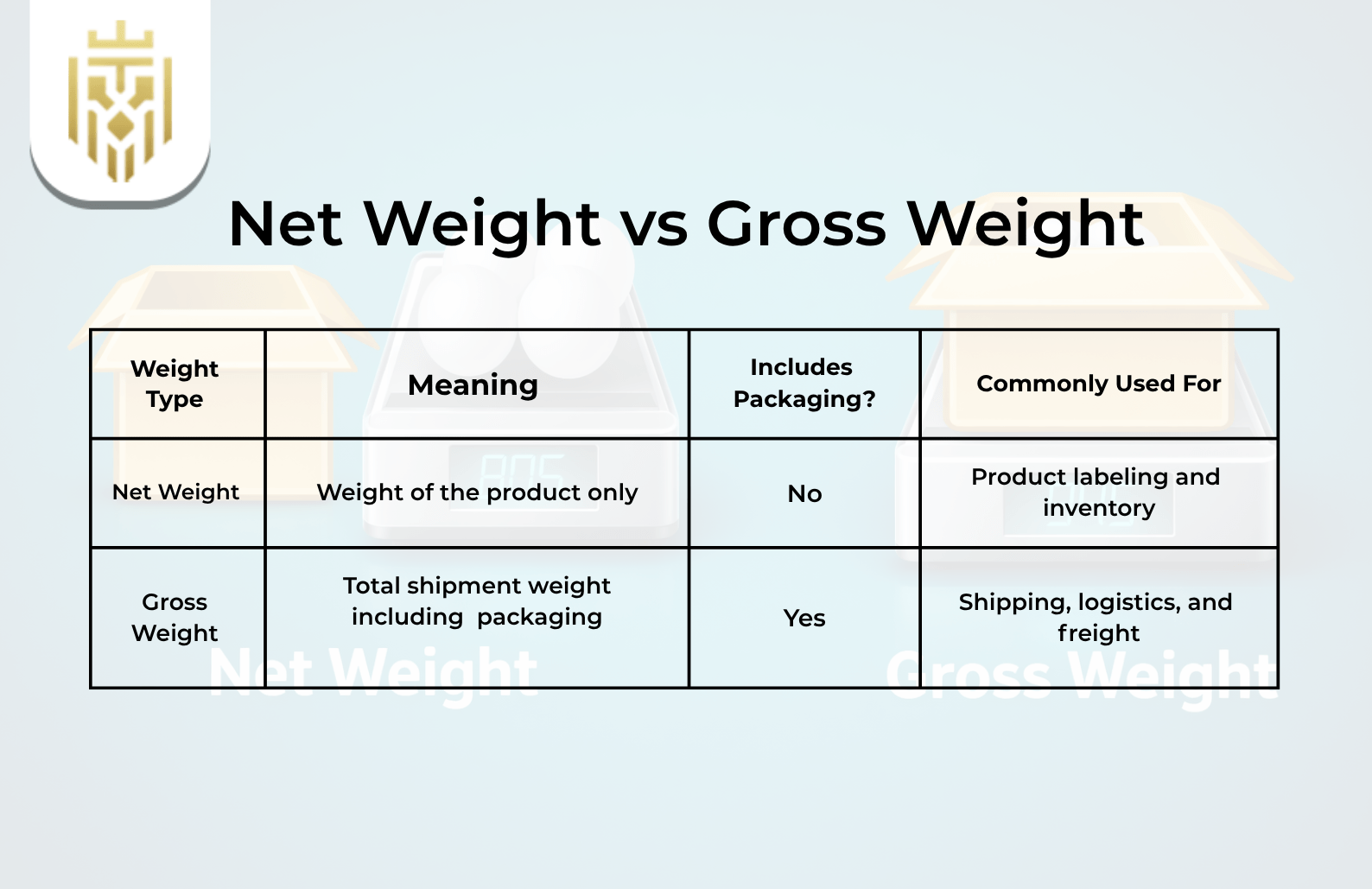
Difference Between Gross and Net Weight
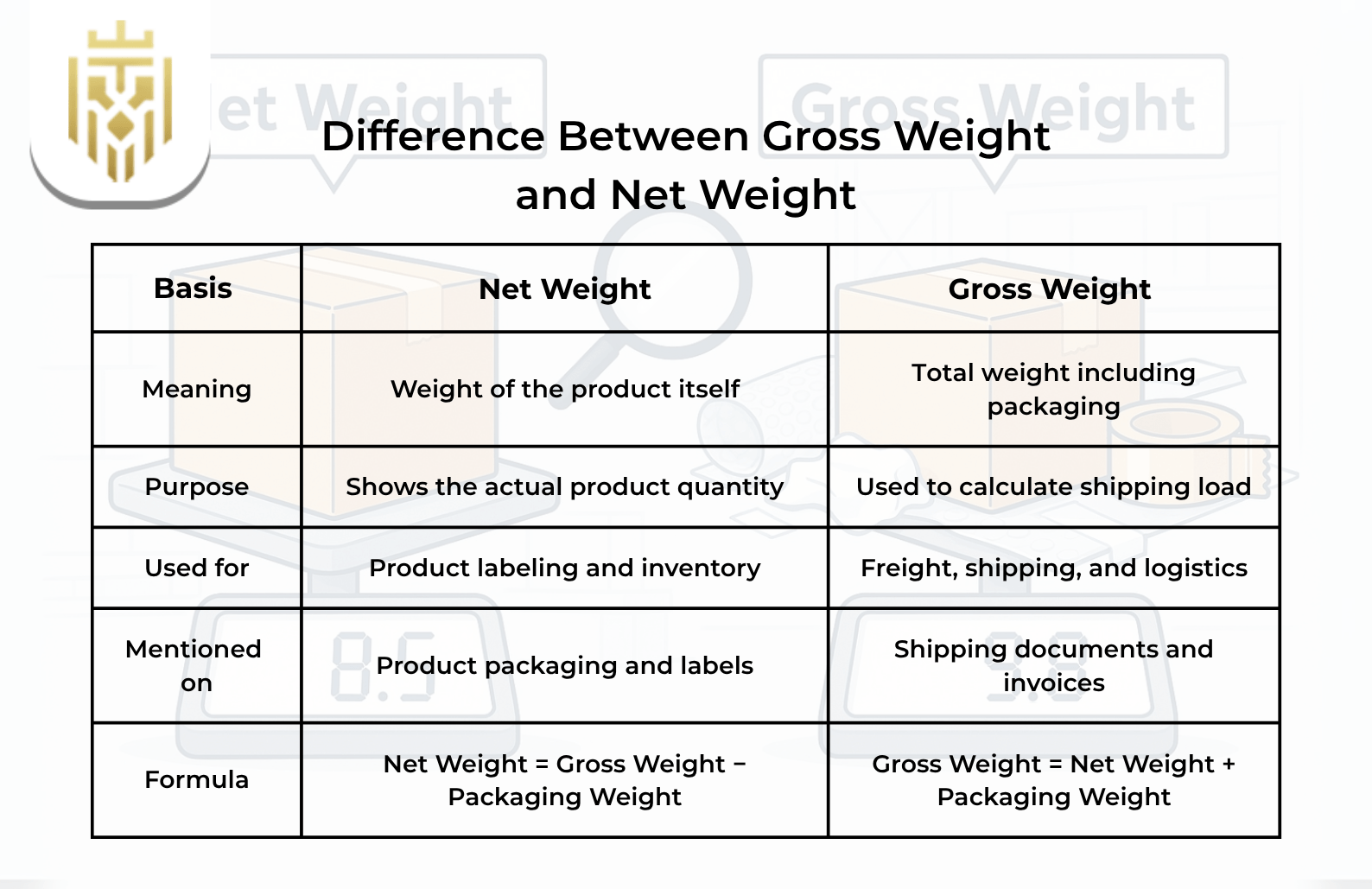
Understanding the difference between gross weight and net weight helps businesses manage shipping and packaging more efficiently.
Meaning
Net weight is the products weight without packaging, containers, or wrapping. It shows precisely how much product is inside.
Gross weight includes the product and all packaging like boxes, cartons, pallets, plastic wrap, or shipping containers. This covers everything moved during transport.
Purpose
Net weight tells customers exactly how much product they get when buying or receiving it.
Gross weight helps trucking companies figure out how much to carry. It allows them to calculate shipping fees based on total load.
Used for
Net weight is typically employed for product labeling, stock control, and retail packaging. It assists producers and sellers in monitoring the precise amount of goods.
Gross weight mainly finds its application in the areas of logistics, cargo transport, and shipping activities. It enables transportation firms to strategize the stacking of vehicles and to regulate the space available for shipments.
Mentioned on
Net weight is commonly displayed on product labels and packaging, allowing customers to easily identify the quantity of the product they are purchasing.
Gross weight, on the other hand, is mainly indicated on the shipping documents like packing lists, freight invoices, bills of lading, and other related logistics paperwork.
Formula
Calculating shipment weights follows straightforward formulas widely applied in logistics.
These formulas let companies get precise weights and keep accurate logs for transport and inventory.
Net Weight = Gross Weight − Packaging Weight
Gross Weight = Net Weight + Packaging Weight
These formulas help businesses accurately calculate shipment weights and maintain proper records for transportation and inventory management.
FAQ
1) What is net weight?
Net weight refers to the products mass without any boxes, wrappers, or containers. It only includes the item itself, not anything it’s wrapped in or stored in.
2) What is gross weight?
Gross weight is the full weight of the shipment. This includes the product and all materials like boxes, wrapping, and containers used during shipping.
3) How to calculate net weight?
Net weight can be calculated using the formula:
Net Weight = Gross Weight − Packaging Weight
4) What is the main difference between gross weight and net weight?
Net weight shows just the product mass. Gross weight adds in all packaging materials that were used in delivery.
5) How to calculate gross weight?
Gross weight can be calculated using the formula:
Gross Weight = Net Weight + Packaging Weight