Have you ever wondered how a small mistake in writing an address on an envelope can have huge impact on the delivery of the envelope? That can be frustrating, especially if the letter contains something important.
Even though a lot of communication has moved online, physical mail is still widely used for business documents, official paperwork, and personal correspondence. Still millions of posts get sent across the country every single day, it’s imperative that the address details are clearly written and properly arranged. This will ensure that your post will reach the right person on the right time.
Essential Parts of an Address Format on an Envelope
When you’re writing an address on an envelope, the idea is simple: make it easy for the postman to find the person and the place without guessing. Each line of the address gives a clear clue about where the letter needs to go. If something is missing or written in the wrong order, it can slow things down.
Here are the basic details you should always include.
Recipient’s Full Name
Firstly, you’d need to start with the full name of the person who would be receiving the letter. Write the full name clearly and avoid short forms unless that’s how they normally receive their mail. While sending something official, you could add Mr., Ms., Dr. or job title as and when required. This would be helpful if you’re sending a mail to an office.
House / Flat / Building Number
Secondly, you need to write your house number, number or building number. This is really important. If you don’t include it the postman might not know which house or apartment the letter is for. Make sure you double-check this before sending.
Street Name / Locality
Next write the name of the street and the area or locality. This helps to narrow down where the letter needs to go. In cities lots of areas can have streets with the same name so it is crucial to get the area right. Try to write it and use full names instead of short forms.
Landmark (If Any)
If your address is a bit tricky to find, you can add a known place that is nearby. For example: you could say “near City Hospital” or “opposite Main Market.” This is especially helpful in towns, where house numbers can be hard to spot.
District, state & Country
Then write the district and state. If you’re sending the letter to another country make sure to write the country name in full like UNITED STATES or CANADA. This helps the postal service get your letter to the region.
PIN Code / ZIP Code
When you are sending a letter, the PIN Code is an important part of the address. The PIN Code is a 6-digit number in India that helps the postal system figure out which area the letter is supposed to go to. If some other details are a little unclear the correct PIN Code can still help the letter get to the place. So, you should always make sure to double-check the PIN Code.
Contact Number
You do not have to add a contact number when you are sending a letter but it is a good idea to include it especially when you are sending important documents like the PIN Code details. If the delivery person is not sure about the address they can call the contact number and confirm the location. This acts as an extra safety measure and helps to make sure the letter gets to the right person.
Importance of Writing the Correct Address on an Envelope
Writing the correct address on an envelope is very important. It might not seem like a big thing, but writing the address properly can make a huge difference. A complete address helps your letter move smoothly from one sorting center to another until it finally reaches the right person. When details are missing or unclear, problems seem to occur.
Let’s take a look at why writing the correct address is so important.
Ensures On-Time Delivery
When the address is clear and complete, your letter can move through the postal system without unnecessary stops. The sorting staff don’t have to guess or double-check details. This means your mail reaches the recipient on time, which is especially important for documents, bills, or anything time-sensitive.
Prevents Loss or Misdelivery
The correct address also prevents loss or misdelivery. If important details like the house number or PIN Code are wrong, the letter might end up in the incorrect area. In some cases, it could even get lost. A well-written address reduces the chances of your envelope being delivered to the wrong person or sent to the wrong location.
Essential for Proof of Delivery (POD)
The correct address is essential for Proof of Delivery, especially for couriers and speed post services. If the name and address match correctly, it becomes easier to confirm that the right person received the mail. This is particularly important for business documents, papers or parcels that require confirmation.
Avoids Delivery Delays During Peak Times
During peak seasons such as festivals, sales periods, or year-end business cycles, postal services handle a huge volume of mail. If your address is not clear or is not complete, it may be set aside for manual checking. A clear address will definitely help your mail move faster, even during peak delivery times.
Helps in machine-based sorting
The correct address helps in machine-based sorting. Today many postal systems use machines to sort letters. These machines read the address and PIN Code to decide where the mail should go next. If the address is messy or incorrectly formatted the machine may not read it properly. That can slow down the process and cause delays.
Enables Return of Mail
The correct address enables the return of mail. If for some reason the letter cannot be delivered, a complete and correct address makes it easier to return the mail to the sender. Without the correct address details, even returning the envelope becomes difficult. So, writing the address correctly protects both the sender and the receiver.
Where to Write Address on an Envelope for post?
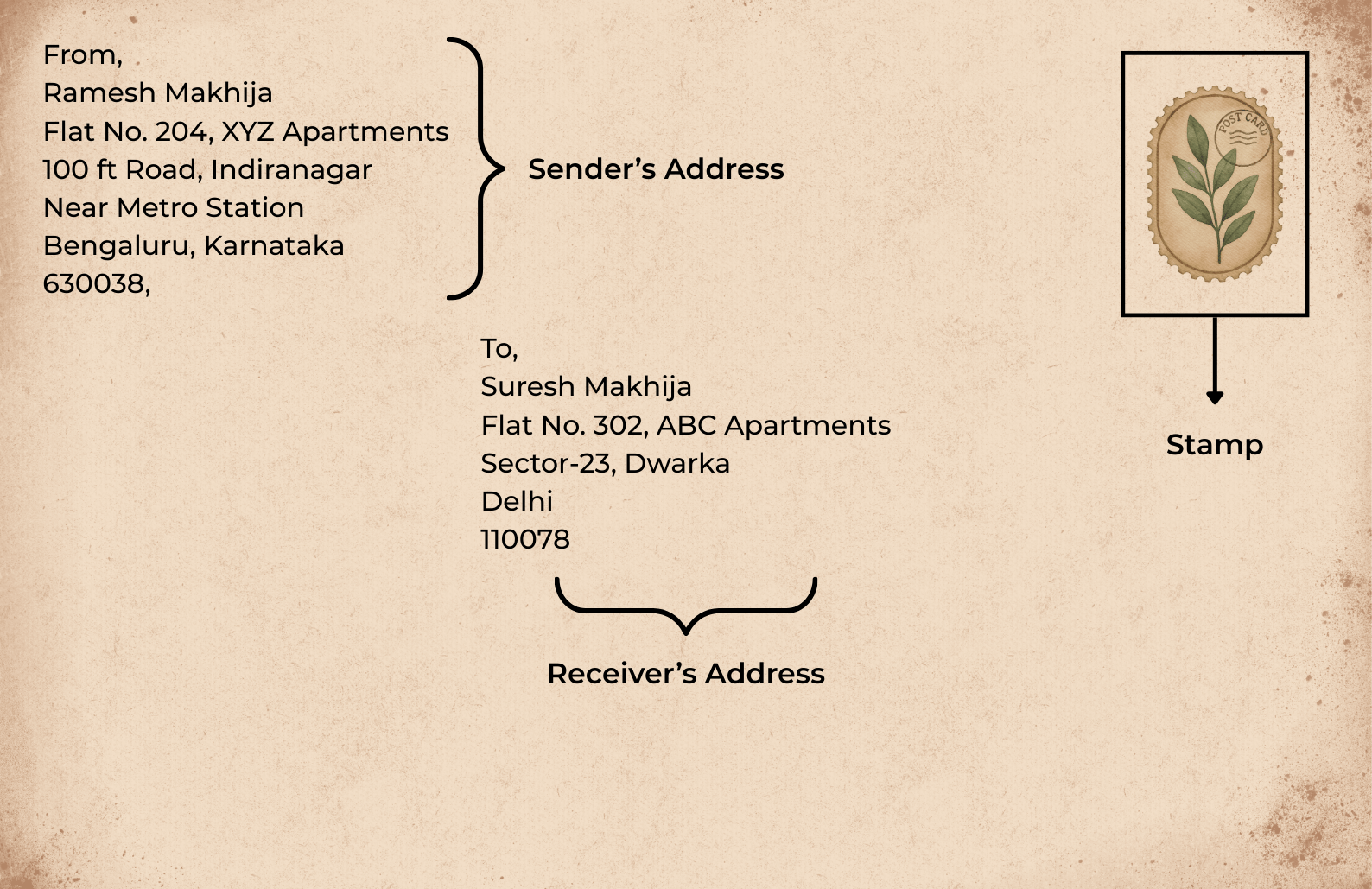
After realizing the significance of writing the address accurately, it is also essential to understand where to put the addresses on the envelope. Even if all the details are correct, writing them in the wrong place can confuse the sorting staff/machine and thus delay the delivery.
Here are the ways you should arrange the address details on an envelope.
Receiver’s Address – Front and Center
The receivers address must be penned on the front side of the envelope, exactly at the center. This is the most visible part of the envelope and the first thing that a mail carrier would look at. Make it a point that the address is written neatly and that each detail is on a different line. Also, leaving a little space around the address makes it easier to read and stamp it.
Sender’s Address – Top Left Corner
The senders address should be the first thing to be written on the envelope and it should be in the top left corner of the envelope. This is so the letter can be returned if it is not deliverable. Others put the senders address on the back of the envelope, which is also allowed in some situations, but the best and safest option is to put it on the front top, left corner.
If there is a problem with delivery, the postal service will take the letter to the address and the return it to the sender.
Stamp – Top Right Corner
The postage stamp should be stuck in the top right corner of the envelope. That spot is set aside for postage marking and cancellation stamps. Make sure not to put any address details here. As a rule, the back side of the envelope is left free. Keeping the envelope clean and tidy is a way to prevent mishandling due to confusion.
How to Write Address on an Envelope for Post?
Familiarizing yourself with the components and their location is only the beginning. Here is a detailed guide on how to compose a perfect address. The approach is easy: present the information in a logical order, make clarity and readability your first priority.
To make it easier to grasp the concept, there are a few practical examples below.
How to Write Receiver’s Address on an Envelope
Put the receivers information right in the middle of the envelope. Start with their name, followed by the house number or flat, street name, locality, district, state, and postal code at the end.
Dont squeeze in all the information together. Each piece of information should be on a separate line.
Example of Receiver’s Address (India)
Ramesh Makhija
Flat No. 204, XYZ Apartments
100 ft Road, Indiranagar
Near Metro Station
Bengaluru, Karnataka
630038
INDIA
Such a layout ensures postal workers can quickly grasp the details.
How to Write Sender’s Address on an Envelope
Your address (the senders address) should be in the top, left corner. The arrangement is opposite the receivers, with the same elements. This is an important step. In case the delivery fails, the post office needs to know where to send back the item.
Example of Sender’s Address (India)
Ramesh Makhija
Flat No. 204, XYZ Apartments
100 ft Road, Indiranagar
Near Metro Station
Bengaluru, Karnataka
630038
INDIA
Double-check the PIN code. A minor mistake could delay its return.
How to Write Addresses on Envelopes for Different Occasions
The fundamental formatting remains unchanged, but there are minor alterations that are necessary, depending on what you are sending.
Personal Letters
For personal letters, make sure the name and complete address are accurate. If the location is difficult to find, you can add a landmark to help. Good and clear handwriting is very necessary, especially if the letter is handwritten.
Official or Government Documents
Sending official documents? Along with the name of the person, also mention their position if necessary. e. g. The Grievance Manager or The District Magistrate. Do not use abbreviations. Always check the spelling and the PIN Code twice because these documents are generally very important.
Business
Business mails should include the company name written clearly, which should be followed by the department name (if necessary). For example, Sales Department or Marketing Department. A contact person’s name in the company can also be mentioned if known. This will make sure that the letter after reaching the organization goes to the right team.
Speed Post or Registered Post
Speed Post or Registered Post requires very clear writing of the address. Besides that, including a phone number right under the address is a very good idea. Since these services usually need confirmation of delivery, providing correct details will prevent delays and unsuccessful delivery attempts.
Common Mistakes to Avoid While Writing Address
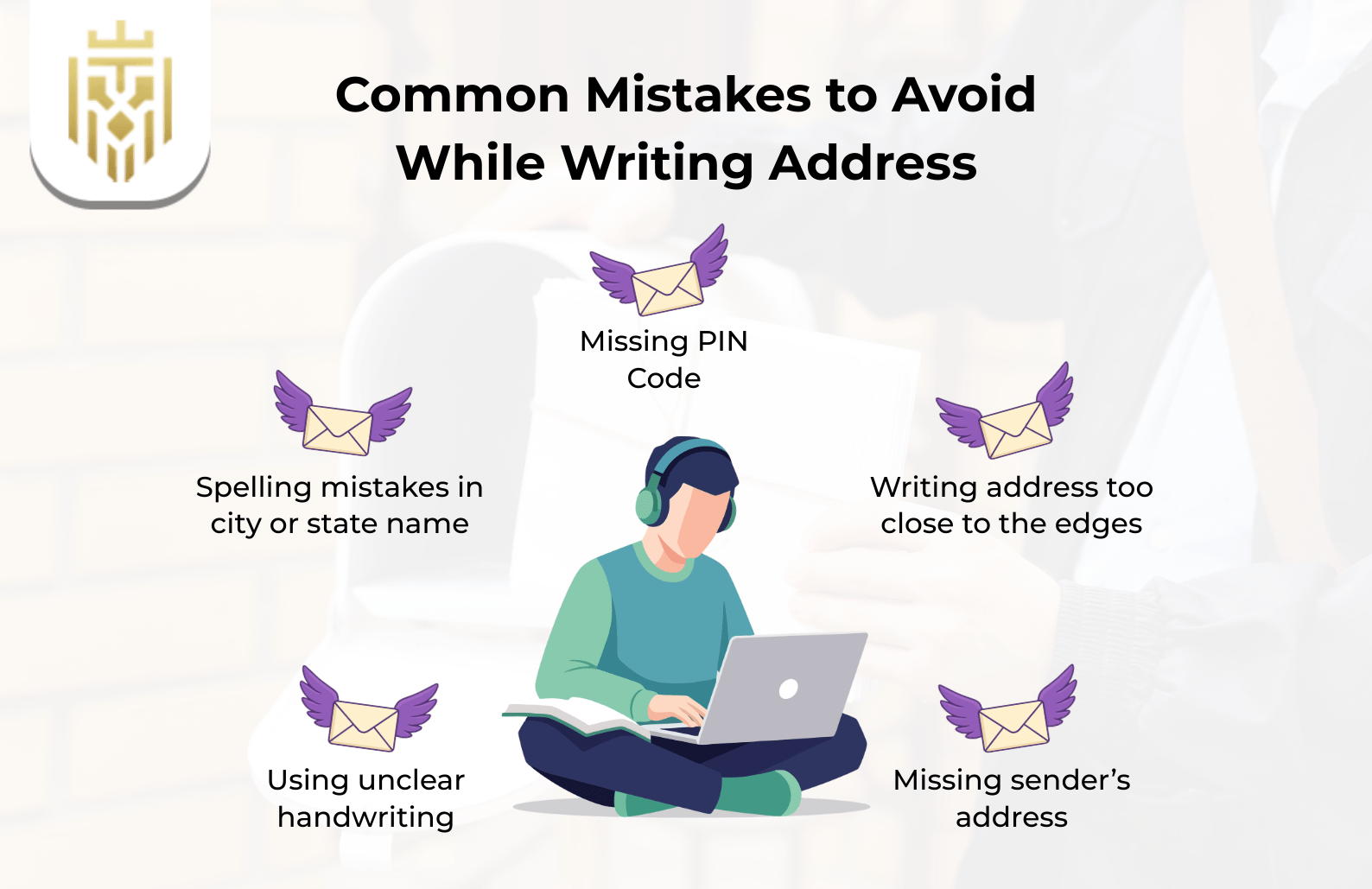
Writing address is a pretty straightforward task, but a few tiny mistakes can ruin everything. Most of the time, parcels are delayed because the address was incomplete or a bit unclear. Just a few seconds more of checking can save you from a lot of trouble later on. Below are some common mistakes that people commit when they write an address on an envelope.
Missing PIN code
One of the most frequent errors is leaving out the PIN Code. In India, the six, digit number plays a vital role in mail sorting. If the PIN Code is absent or incorrect, the letter might be sent to the wrong delivery center or be delayed as the staff tries to locate the correct address. Always verify the PIN Code before sealing the envelope.
Spelling mistakes in city or state name
Incorrect spelling of city or state name can mess up the sorting process. For instance, if a city in one state shares the same name as a city in another state, the letter could be sent to the wrong pole. Even minor spelling errors can lead to significant delays, so it’s advisable to write neatly and accurately.
Writing address too close to the edges
People writing the address too close to the top, bottom, or sides of the envelope can cause problems because the address can be partly covered by stamps, barcodes, or postal markings. Always leave some space around the address so it remains fully visible.
Using unclear handwriting
If the handwriting is a mess or difficult to understand, the postal workers or machines might find it hard to get the details. This can cause a delay in delivery or lead to errors. Use clear and simple letters when writing. If you can, write in uppercase letters to make the text more legible.
Missing sender’s address
It seems that a lot of people dont put their own address (senders address) on the envelope. A problem arises when the letter is not deliverable. If there is no senders address, the postal service wont be able to return the mail in case delivery is an issue. Before sending, always write your address on the envelopes top left corner.
Conclusion
Though it may look like a simple task, there is a lot of significance in writing address on an envelope. Postal services will be able to carry out their work more efficiently with a clear and neat address, and your letter will reach the recipient in time. No matter what the letter contains, a personal note, some documents or a business communication, the right address prevents misunderstandings and errors.
Make sure you have the right name, house number, street, locality, city, state, and first of all the PIN Code, before you drop the envelope in the mail. Don’t forget to indicate the sender’s address. By doing these small things, you save time, avoid wastes, and have a confidence that your mail is traveling the right way.
FAQ
1) How to write an address on an envelope for a post in India?
In order to write an address on an envelope for a in India, you first write the receiver’s full name in the middle of the envelope. House or flat number, street name, area or locality, district, state, and 6, digit PIN Code can be the following lines..
2) Which side to write an address on an envelope in India?
Always put the receiver’s address on the front side of the envelope, right in the center. Put the sender’s address on the top left corner of the front side.
3) What are the common mistakes to avoid when writing an address on an envelope?
Some common mistakes that people do when addressing an envelope include not writing the PIN Code, misspelling the city or state name, writing too close to the edges, having unclear handwriting, and not including the senders address.
4) How to write the receiver’s address on an envelope?
Start by writing down the receiver’s full name and afterwards, mention the house or flat number, street name, locality, district, state, and PIN Code.
5) How to write the sender’s address on an envelope?
The sender’s address should be put on the top left corner of the front of the envelope. The format is the same as that of the receiver’s address: full name, house number, street, area, district, state, and PIN Code.