Cyclone Ditwah formed over the southwest Bay of Bengal from a deepening low-pressure system strengthened by warm sea temperatures and favourable winds, later making landfall in Sri Lanka before impacting southern India with heavy rains and strong winds. Its strong impact resulted in large-scale destruction, and disaster logistics significantly affected efficient emergency management, movement of resources, and humanitarian organisation at each stage of the crisis
Disaster Logistics in the Cyclone Ditwah Response
The response to Cyclone Ditwah was based on efficient disaster logistics, where the speed of supply movement, coordinated teams, and technological decisions were put into action. This strategy enhanced disaster relief logistics and boosted humanitarian logistics and emergency response strategies, along with assisting the broader disaster supply chain management system required to stabilise the impacted communities.
What Is Disaster Logistics Management?
Disaster logistics management refers to the structured planning, rapid transportation, and coordinated distribution of essential resources that ensure timely relief, efficient crisis response, and continuity of aid during emergencies. Understanding what is disaster logistics through the lenses of Cyclone Ditwah requires one to study the measures taken to protect affected people, like supplying food, delivering medical support, ensuring safe evacuation, restoring critical services, and maintaining a responsive supply chain despite the disaster’s impact.
Key Requirements of Disaster Logistics Management
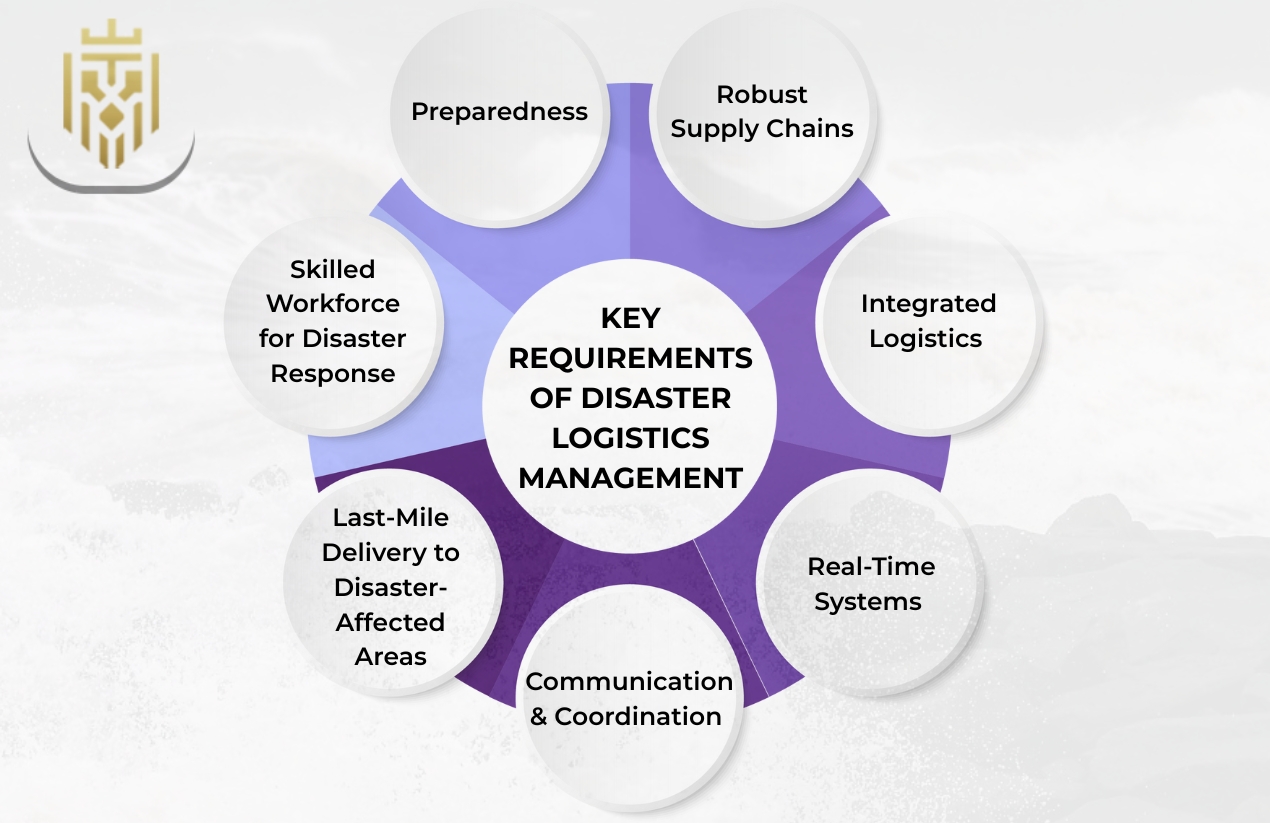
Some of the key requirements were effective planning, real-time data, competent work teams and dynamic transportation networks. Those guaranteed efficient emergency logistics, strengthened logistics during the disaster management, and allowed the smooth operation of disaster response measures that provided prompt assistance and preserved the necessary humanitarian logistics activities throughout the course of Cyclone Ditwah.
Preparedness
Good preparedness in Cyclone Ditwah focused on planning ahead and pre-positioning supplies and trained teams. These actions enhanced the logistics of the disaster, bolstered the crisis management and facilitated the operations of emergency responders. This proactive preparedness also assisted in disaster management logistics to mobilise quicker and minimise delays on the initial impact of the cyclone.
Robust Supply Chains
The relief efforts needed dynamic and resilient supply chains that could be modified according to the blocked routes and changing demand. This strategy advanced the management of the disaster supply chain, the humanitarian logistics, and the relief logistics. These flexible systems further strengthened the general contribution of the logistics in disasters so that a response to aid is made in time.
Integrated Logistics
Cyclone Ditwah required smooth co-ordination of procurement, transportation, warehousing and the last-mile distribution. This harmonisation enhanced disaster logistics management, enhanced emergency logistics and coordinated disaster response. A free movement through the stages also facilitated the logistics in disaster management by minimising the bottlenecks and maximising the efficiency in its operations during the relief process.
Real-Time Systems for Ditwah Planning
During Cyclone Ditwah, information systems enhanced real-time information to aid forecasting, route decisions and allocation of resources. These computer-based tools helped with disaster logistics, crisis management, and humanitarian logistics planning. Proper data also enhanced the logistics concerning the management of disasters, and this allowed the teams to react quicker to the dynamics on the ground.
Communication & Coordination in Ditwah Operations
During Cyclone Ditwah, effective communication and multi-agency coordination played an important role, which meant that activities were coordinated and decisions were made in a timely fashion. This enhanced disaster relief logistics, enhanced disaster response and enhanced efficient relief logistics. This type of cooperation also enhanced disaster logistics management, which saved cohesiveness in government, NGO, and military activities.
Last-Mile Delivery to Cyclone Ditwah-Affected Areas
Last-mile delivery saw that important supplies were delivered to remote or isolated areas affected by Cyclone Ditwah. These specific activities supported humanitarian logistics, emergency logistics, and community-level disaster response. Efficient delivery also demonstrated the central importance of logistics in disasters, so no affected zone was not named.
Skilled Workforce for Ditwah Response
Cyclone Ditwah needed highly qualified staff who have been trained in transport planning, warehousing and disaster logistical management. Their experience improved emergency management, reinforced humanitarian logistics and made operations smoother. The clear-cut workforce also enhanced logistics in managing the disaster scenario, which made possible the timely co-ordination and the systematic relief distribution in all the affected regions.
Stages of Disaster Logistics during Cyclone Ditwah
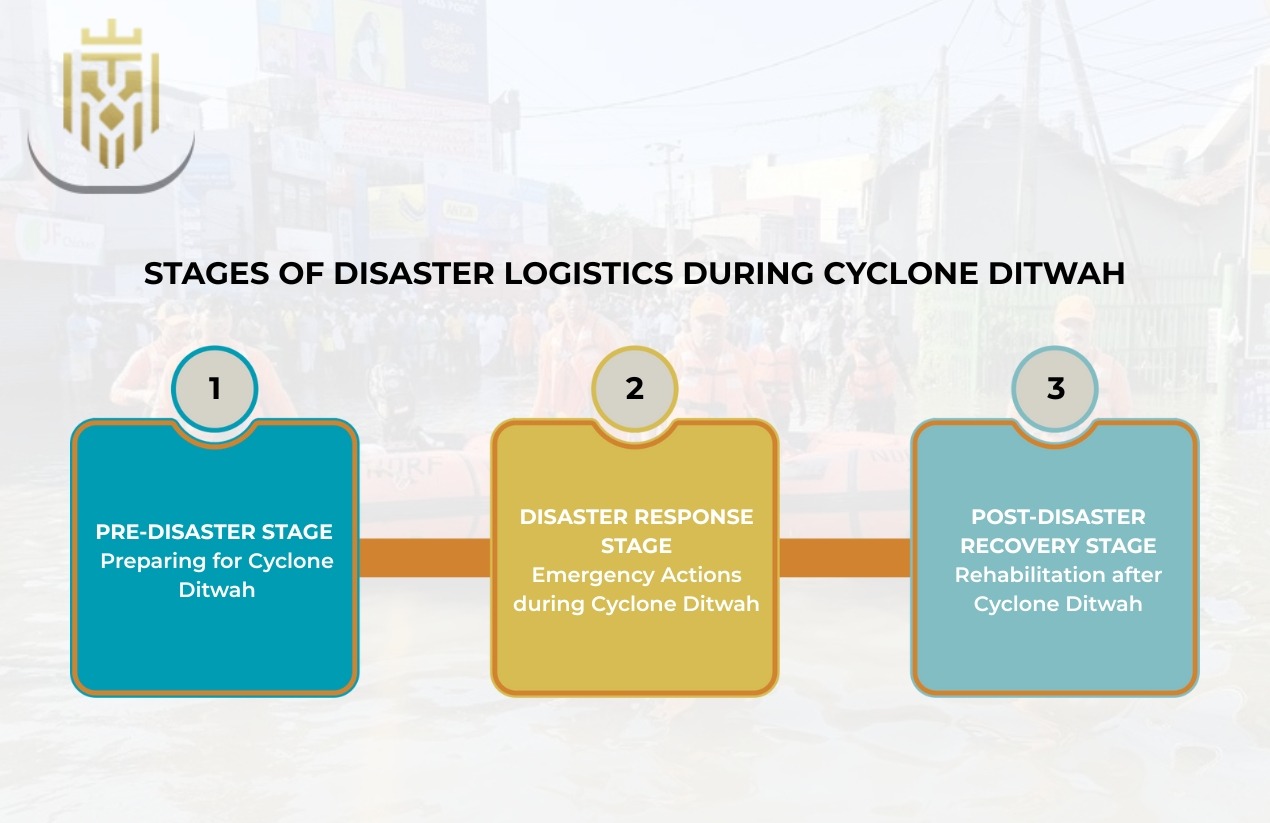
These stages were preparedness, response and recovery, each of which is required to make disaster logistics effective. These stages were in favour of disaster supply chain management, emergency logistics, and relief logistics organisation. The awareness of these phases also helps to explain what disaster logistics is, as it is a systematic role during emergencies at such a large scale as Cyclone Ditwah.
Pre-Disaster Stage – Preparing for Cyclone Ditwah
The pre-disaster stage entailed disaster logistics management through the pre-positioning of supplies and risk mapping to foster forecasting and involve disaster forecasting. These proactive measures improved crisis management and logistics in support of emergencies and aligned with the overall logistics in disaster management. This kind of preparation demystified what constitutes disaster logistics, whereby more planned and coordinated activities ensued at the time of Cyclone Ditwah.
Disaster Response Stage – Emergency Actions during Cyclone Ditwah
In Cyclone Ditwah, fast evaluation, direct flow of supplies, and crisis distribution characterised the response phase. The actions reflected effective disaster management, effective logistics of relief, and responsive humanitarian logistics. This also included good coordination to bolster the disaster logistics, which contributed to the greater role of logistics in disasters across the whole process of saving lives.
Post-Disaster Recovery Stage – Rehabilitation after Cyclone Ditwah
The focus in recovery was on rebuilding infrastructure, reinstating supply chains and helping communities in the long term. The stage was dependent on the disaster supply chain management, organised humanitarian logistics and continued crisis management. It also revealed the development of emergency response transforming to long-term disaster logistics management, which guarantees stable rehabilitation following Cyclone Ditwah.
Types of Disasters & Their Logistics Response Needs
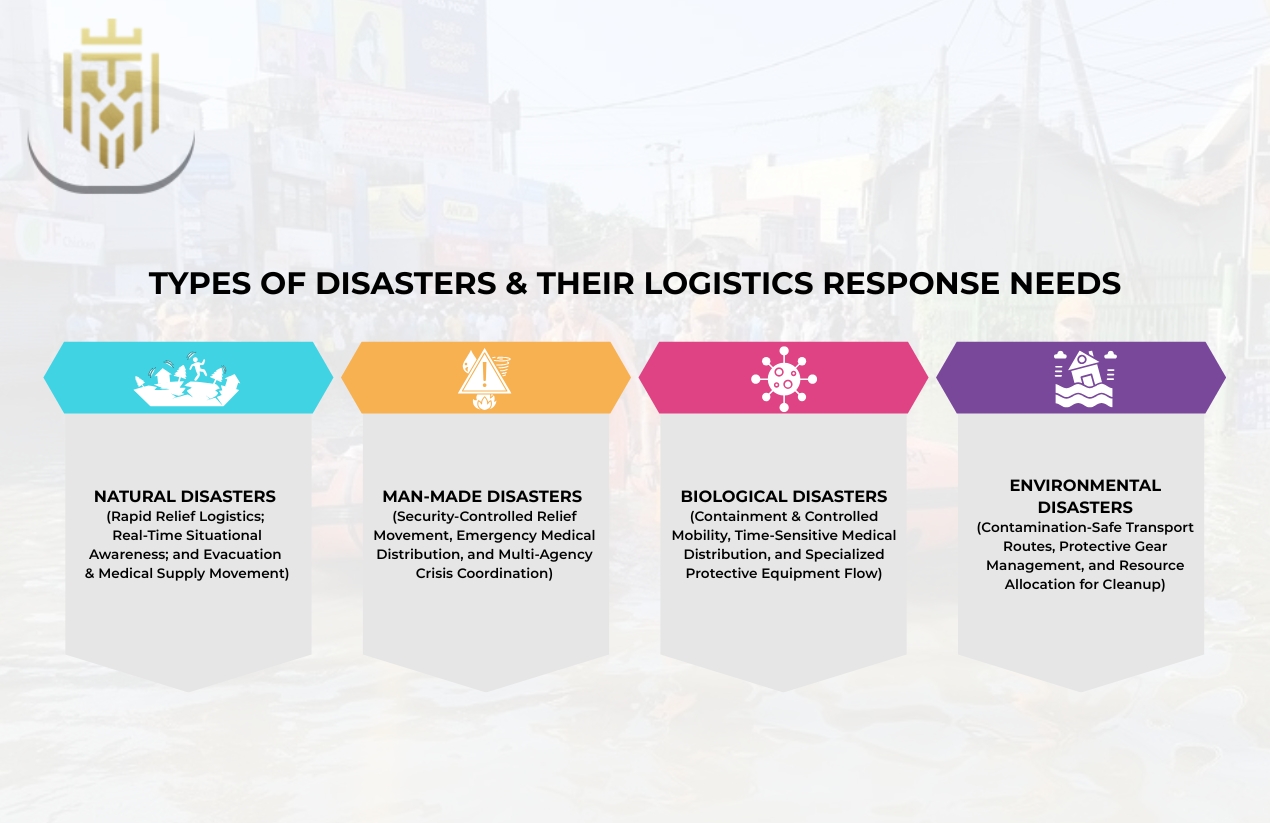
There are specific strategies in disaster cases, and Cyclone Ditwah emphasised the importance of strong disaster logistics, coordinated humanitarian logistics and efficient disaster supply chain management. Knowing these categories helps in planning and responding to emergencies more efficiently and also in having a clear picture of what is disaster logistics in practice.
Natural Disasters
Natural disasters such as Cyclone Ditwah illustrate the essence of rapid disaster relief logistics, elastic emergency logistics, and coordinated disaster response. This incident further strengthened the importance of logistics during disasters, particularly with the breakdown of infrastructure and in places where people are largely dependent on well-disciplined humanitarian aid.
Logistics Needs
Cyclone Ditwah demanded expedited relief logistics, real-time situational awareness and reliable disaster logistics management. The basic needs were evacuation, movement of medical supplies, and recovery of the supply chain. These aspects fortified knowledge on logistics in disaster management in particular times when the crises are unpredictable and dynamic.
Man-Made Disasters
Artificial calamities such as industrial incidents, conflicts, etc. require organised humanitarian logistics, coordinated emergency response, and extremely flexible disaster logistics. Their complexity underscores the importance of logistics during disasters, particularly when long-standing systems cannot perform their tasks and there is a need to have a multi-agency response.
Logistics Needs
Artificial cataclysms demand emergency medical shipments, security-regulated transport, and effective crisis management. Through sound management of disaster supply chains, there is continuity in delivering relief to those affected as well as the preservation of fundamental tenets of what constitutes disaster logistics, which are especially needed in settings of limited access or danger to safety.
Biological Disasters
Biological outbreaks require stringent containment logistics, expert humanitarian logistics, and disaster logistics management on a high level of accuracy. These situations show that the role of logistics in disasters is growing larger, particularly when time-critical medical supplies and restricted movement are considered the major parts of successful crisis response.
Logistics Needs
Medical goods, distribution of protective equipment, and flawless emergency logistics should be delivered safely due to the biological crisis. The synchronised disaster response and real-time monitoring are a guarantee of timely measures to be taken, which reinforces the broader system of logistics in disaster management in the case of a public health emergency.
Environmental Disasters
It can be seen with references to environmental disasters like chemical leaks or any other pollution event that it requires specialised disaster logistics, trained staff, and sophisticated crisis management. Such disasters also underline the meaning of disaster logistics, highlighting the significance of mobility that is safe enough to overcome contamination and the accuracy of asset distribution.
Logistics Needs
Environmental emergencies demand that transport corridors be controlled, that protective equipment be in place and that emergency response be quick. Sound disaster supply chain management helps in cleanup efforts and protection, and humanitarian logistics means that the affected communities can get the necessary support without being exposed to dangerous environments.
Common Challenges in Disaster Logistics
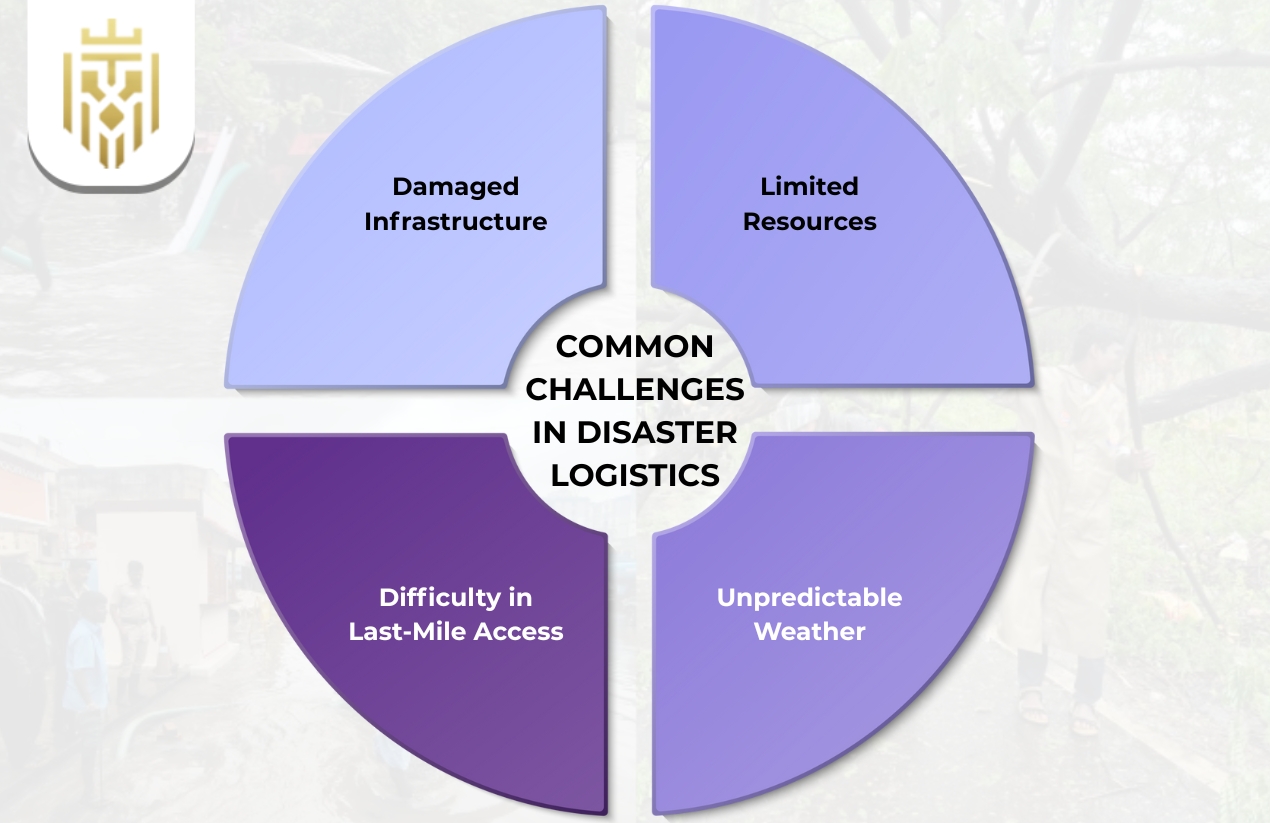
Cyclone Ditwah revealed major problems such as broken infrastructure, shortages, and delays in the coordination process. The greater role of logistics in disasters needs to be strengthened through stronger disaster logistics management, adaptive emergency logistics, and more integrated relief logistics.
Damaged Infrastructure
Infrastructure failure put strain on the logistics of disasters, limited the distribution of relief supplies, and slackened humanitarian logistics. This difficulty highlighted the importance of disaster supply chain management in terms of relying on resilient roads, communication infrastructure, and transport infrastructure that could support the emergencies on time.
Limited Resources
The lack of resources influenced the rapidity and effectiveness of emergency service, making it hard to manage disaster logistics. Existing manpower, fuel and supplies were a challenge to the whole supply chain, which serves as a sign of the importance of strategic forecasting as a wider concept of disaster management logistics.
Unpredictable Weather
Changing weather interfered with relief logistics, evacuation and emergency logistics planning. This uncertainty led to further justification of the use of data-driven forecasting in disaster logistics to help the teams stay flexible in the face of sudden changes in the environment.
Difficulty in Last-Mile Access
Clogged roads and inundated roads hindered disaster recovery, and it became challenging to deliver aid to people in the end. These hiccups during the last-mile events showed how crucial logistics is during disasters and that disaster supply chain management requires a more powerful and adaptable approach.
How Technology Supports Disaster Logistics Management
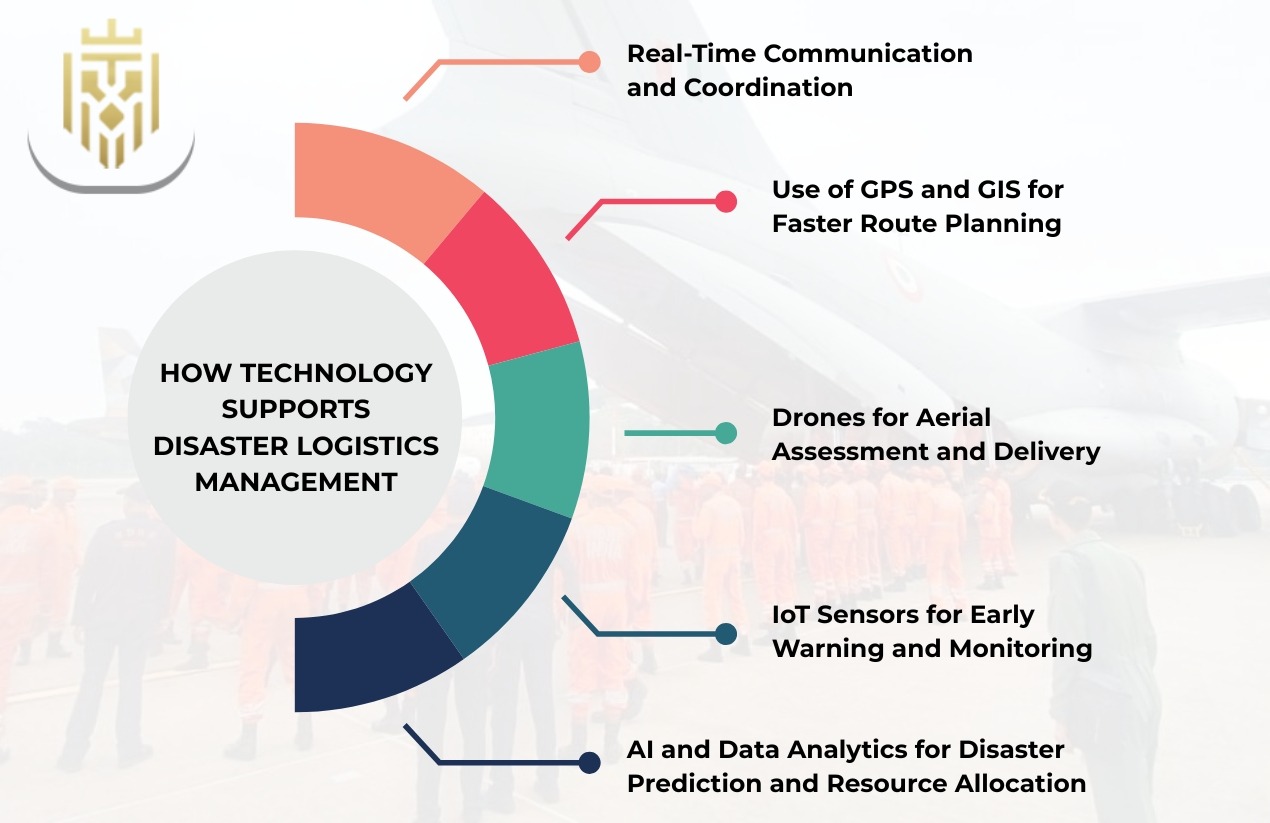
Technology has been instrumental in enhancing disaster logistics management, enhancing route planning, communication, and real-time situational awareness. These tools improved emergency response, optimised humanitarian logistics, and supported the broader aims of disaster supply chain management throughout Cyclone Ditwah.
Real-Time Communication and Coordination
The digital communication systems enhanced the coordination among the agencies, made disaster logistics and relief logistics faster, and improved decision-making. This enhanced the functional role of logistics during disasters so that there is a coordinated response action during Cyclone Ditwah.
Use of GPS and GIS for Faster Route Planning
The GPS and GIS technology was used to make emergency logistics teams responsive in terms of route changes. These available tools have been used to support disaster supply chain management, eliminate delays and enhance navigation in the impacted areas, which reinforced visibility in the larger disaster logistical processes.
Drones for Aerial Assessment and Delivery
Drones offered fast testing, helped in disaster response, and allowed precise relief logistics deliveries to unreachable locations. They advanced the real-time effectiveness in humanitarian logistics and increased the knowledge of the meaning of disaster logistics in current operations.
IoT Sensors for Early Warning and Monitoring
IoT sensors enhanced early warning, enhanced crisis management and assisted in managing the logistics of the disaster proactively. Such technologies contributed to the increase in tracking of the changes in weather and risks of infrastructure, which strengthens the role of logistics in disaster management.
AI and Data Analytics for Disaster Prediction and Resource Allocation
The AI tools were used to forecast storm patterns and optimise supply chain flows as well as enhance emergency response allocation. They facilitated the real-time disaster logistics, whereby they facilitated more precise planning, in line with the overall disaster supply chain management requirements.
FAQ
1) What Is Disaster Logistics Management?
Disaster logistics management is the planning, coordinating and delivering of the necessary resources of relief in times of disaster. It provides efficient supply, staffing, and information flow to assist in responding to the disaster, stabilising the situation, and alleviating human suffering.
2) What are the key requirements of disaster logistics management during Cyclone Ditwah?
Cyclone Ditwah demanded high preparedness, real-time communication, humanitarian logistics flexibility, dependable transport channels, combined response teams, effective disaster supply chain management, and speedy last-mile delivery to provide timely relief to the affected populations.
3) How Technology Supports Disaster Logistics Management during Cyclone Ditwah?
The application of technology enhanced the response to Cyclone Ditwah by the use of GPS route planning, drone assessment, digital tracking, GIS mapping, IoT sensors, and communication tools to improve emergency logistics, decision-making, and distribution of essential relief materials.
4) What are the Stages of Disaster Logistics in the context of Cyclone Ditwah?
The logistics of Cyclone Ditwah consisted of three levels: preparedness for disasters, supplying the emergency with a rapid movement, and post-disaster recovery aimed at the reconstruction of the facilities, the efficiency of deliveries, and the improvements in managing the crises long-term.